Art School Drop Out
As the title suggests, not only did I drop out of art school, I actually did it twice. I went through the whole application process, got in to two different programs and gave it my all. But try as I might, I just couldn’t do it. The school was the Savannah College of Art & Design in Savannah, Georgia USA. It’s regarded as one of the top art schools in the United States. I made it about 30 hours into their graduate-level Motion Media and Game Design programs while working full-time.
Art schools typically require a portfolio (usually condensed into a “showreel”) demonstrating at least some proficiency in the craft. Here was where my art “career” ended up:
In this article, I’ll share my motivations for art school along with my experience in hopes that it might help someone on the fence about art school decide if it’s a path worth exploring, especially in the age of Artificial Intelligence.
My background
That’s a bit of a loaded question: Why did I choose art school? The cheap answers are things like:
- I wanted a better life for my family.
- I liked being creative and wanted to get paid (more) for it.
- I wanted direction and feedback on the path I was taking from people who’ve already taken the journey.
All of these are partially true, but also cheap. They don’t tell the full story.
Undergrad
I promise I will get back to the art school bit. But first, some background. When I went to undergrad at Truman State University in 2005, I was pretty undecided about what I wanted to do. My family was poor, and I was just pinching myself that I even got to go. All my friends were headed to school and I just couldn’t miss out. I knew I loved learning, but had no idea what to do with that knowledge. Thanks to Federal Pell Grants and a giant interest-free loan from the Scholarship Foundation of St. Louis, I was off to college. I couldn’t major in “Undecided” so I chose the next most open-ended field of study, Business. Was it the worst choice I’ve ever made? Not by a long shot. The degree in 2009 got me a job so I could start paying back all those loans. It gave me a place to find purpose. And my job gave me an educational benefit where they’d cover even more education.
Early Career
I saw school as a place to invest in my personal intellectual property so I couldn’t keep myself out of the classroom. Five years into the workforce I was back at school, this time for Information Management at Washington University in St. Louis. Up to this point I was working in the finance function at Boeing, even though I cared little for financial reporting and business planning. I did enjoy building dashboards, presentations, and geeking out on technology. So, I thought maybe I can jump into the IT field. The ticket for entry at that time was some kind of “technical” degree. By 2014, I got my Masters in Information Management. This program didn’t get into programming; it was more of a leadership and project management curriculum. I was fascinated with how some could inspire others to act, think, and feel, using little more than words. Here, I started getting the tools and practice building and leading teams, managing conflict, and designing and executing project plans.
The Story Guy
While at grad school, I was introduced to the work of Clayton Christensen, Alex Osterwalder, and Seth Godin, immersing myself in the entrepreneurial milieu of St. Louis during those days. It was this period from 2012-2018, where I really started to find a place for myself at work as a “story guy.” During this time I also moved from St. Louis, MO to Charleston, SC and it was common for folks to ask me to help build pitch decks, websites, and eventually videos. My fascination with how words affected peoples’ behavior, thoughts, and beliefs started to include images as well. I just noticed how much more engaged people were with a message included visuals. While perusing the shelves of the West Ashley library, I came across a book by Dan Roam called Show and Tell. The book weaved psychology, narrative structures, and visualization techniques in a way that made me realize just how much I didn’t know. Dan Roam is great at giving just enough information for people to get results. But, I wanted to be the best I could possibly be. With all the media I was getting asked to produce, the next step was to learn the fundamentals of graphic design and apply it to the work I was doing. Words were not enough.
Tacking on Graphic Design
My appetite for learning all of the tools and techniques of the graphic design trade was insatiable. Here was a field, a relative to all the psychology courses I was taking on leadership and communication, that could go as deep as I wanted. I realized design wasn’t just aesthetic; it was about perception, cognition, and behavior. It was the perfect complement to all the leadership training I received during my Masters degree. The learning curve for all the graphic design tools was steep, though. I went on YouTube, paid thousands for online courses, and completed as many “personal projects” as I could fit in my work schedule.
Shout out to School of Motion for the great learning content, especially my first mentor there, the very talented Luis Miranda. It was through School of Motion where the tools really started to make sense and became less of a barrier to getting complex ideas explained visually. Here are a couple early assignments from their course on animation, all done with Adobe After Effects.
3D: The Final Frontier
It was in 2019, when I was introduced to 3D design and animation, that a new phase opened up for me. Now I could blend the physical and digital worlds. I could make interactive experiences. I could see immediate application to my Boeing work with all the talk of Digital Twins and Generative Design being tossed around. But you talk about a field as deep as you want to go, I don’t think there’s anything more complex in the graphic design field than 3D design. 3D design and animation involves blending the fields of graphic design, computer science, cinematography, sculpting, architecture, anatomy and even fashion (more on that later).
Even with all the online courses and personal projects completed, I still didn’t have the nerve to call myself a 3D designer. Plus, I wasn’t sure if graphic design was a field I wanted to go down. It would mean starting over for me and I felt like I’d be throwing away a decade of solid experience away if I considered myself “just a 3D designer.” No disrespect for the 100% 3D designers out there. These folks are brilliant. They just weren’t me. And that was the biggest obstacle I needed to figure out: where did I belong? In a nutshell, that was the reason I went to art school: to find a place I might belong.
My Expectations
After putting together a showreel, gathering reference letters, drafting my statement of purpose, I got my acceptance into the SCAD Master of Fine Arts in Motion Media graduate program. I started at SCAD in the middle of the pandemic, when Boeing was making its way through the most challenging time of my time there. The skies had far fewer people in them and a couple of horrific accidents left the future of the company (and those of us working there) in an unpredictable place. While Boeing funded my first degree, a degree in Motion Media wasn’t considered a strategic area of study so I covered the costs out of pocket. So, my expectations were high, both for SCAD and myself. I wasn’t there to waste time and certainly not my money. I looked at every lecture, every assignment, every group project as either an asset or liability for my future (there’s that darn business degree, I guess?). And with my wife and I wanting to start a family, I knew I needed to make my decision to stay or go quickly. I didn’t have the luxury of time so I needed to see some sort of return on my time there.
My Experience
Getting started at SCAD
My experience with art school started in 2021 was mixed, meaning it wasn’t all good or bad. The professors were passionate about their craft. They were all great at communicating ideas and giving clear guidance…literally the opposite of what “real life” can be like sometimes. Yes, condescension was a thing, especially in the art appreciation classes. There are also some classes where you can tell the professors have the assignments and lectures practically on auto-play. It’s hard to get real feedback from professors like that as they seem to see interacting with students and passing on knowledge as a burden that gets in the way of their more pressing work. That’s the thing with SCAD, the professors are expected to stay tethered to “industry” so as not to drift too far from orbit of the working world. This is a great benefit for students because these professors know the current tools, trends, and challenges of the industries they support. The risk is you may have professors who struggle to stay tethered enough to their students. This results in lectures that you’d be better off finding on YouTube.
CoMotion
Overall, the good experiences far outweighed the bad, due to how many opportunities SCAD puts students in the same space as business leaders. The Motion Media School at SCAD puts on an annual celebration of the motion industry called CoMotion. It’s a great opportunity for students to meet working professionals in their industry and start building connections. As a student, you get exclusive access to these industry professionals at “speed-dating” interview sessions. I’ve seen Boeing do the same thing with their rotation programs where entry-level hires can quickly meet many different hiring managers to see who they “vibe” with before making a decision on where to work next. It was at the 2021 CoMotion when, as a student, I had a chance to meet with Erin Sarofsky, a brilliant founder of her own creative studio. Her team worked on Hollywood movies, TV ads, film titles, arena graphics…they could do anything. About a month or so after CoMotion, I get an email through my website asking if I was interested in interning with her team at Sarofsky. Keep in mind, I’m still working full-time at Boeing and going to grad school part-time. Fortunately for me, my manager at Boeing approved a sabbatical for me to spend some time with the team at Sarofsky during the summer of 2022.
Sabbatical
After getting the sabbatical approved at work, I jumped in at Sarofsky, feeling like I just started my career all over again. I’m one of the few “elder millennials” that will actually know what it feels like to “intern” on an all-remote team during COVID. I had a chance to support a number of pitches for film titles and commercials. One of of my favorite projects was working on style frames for a show that is actually out now, Citadel.
For those who don’t know, studios will pitch several “rough” ideas for a title sequence early on to determine the interests of their clients, without spending a fortune on creating final and polished frames. Sarofsky asked me, along with a few other artists, to come up with some ideas for the pitch. The other artists had so much more going on with their shots…3D terrains, Fake User Interfaces, chromatic aberration for days …all the cool stuff you’d expect from modern motion designers. After watching recordings of a few early meetings with the show’s production team and reading through A LOT of notes, I went a different direction. Recognizing the show’s theme of questioning some of history’s biggest moments, I chose to pursue this montage of revisited moments in time, but with an altered/distorted lens. Turns out that idea was the one the client chose to pursue.
I ended up working on several projects like this under the creative leadership of Duarte Elvas, who challenged me to be more of a clever and considerate designer.
Here’s my first assignment when joining Sarofsky…putting together a short social media video introducing me to Sarofsky’s social media followers:
It was fun trying out a different career, but it just wasn’t for me. I’m sure it had more to do with COVID, but I really missed talking with clients and solving strategic problems. I’m still super grateful for getting to learn about how a great creative operates and even more grateful for my Boeing manager who approved my sabbatical!
Game Design and the AI Invasion
Even though I wasn’t into the motion design work, I still loved creating 3D media. In 2022, I pivoted to game design and learned Unreal Engine. The upside was huge because not only were motion designers already starting to transition to real-time game engines, there were so many other applications, especially for interactive experiences. By this time, I had taken off from SCAD for close to a year so I had to reapply for admission, this time to the SCAD Game Design MFA program.
This time around, I feel like I had found my people. I’ve never been a gamer, though I have printed out several copies of the Valve Employee Handbook and left it on random Boeing executives’ desks over the years. Game designers have historically been unbelievably talented people, traversing multiple disciplines to become what Valve calls the T-shaped employee. The professors were no different. In fact, Professor Nye Warburton was easily the best part of my whole SCAD experience.
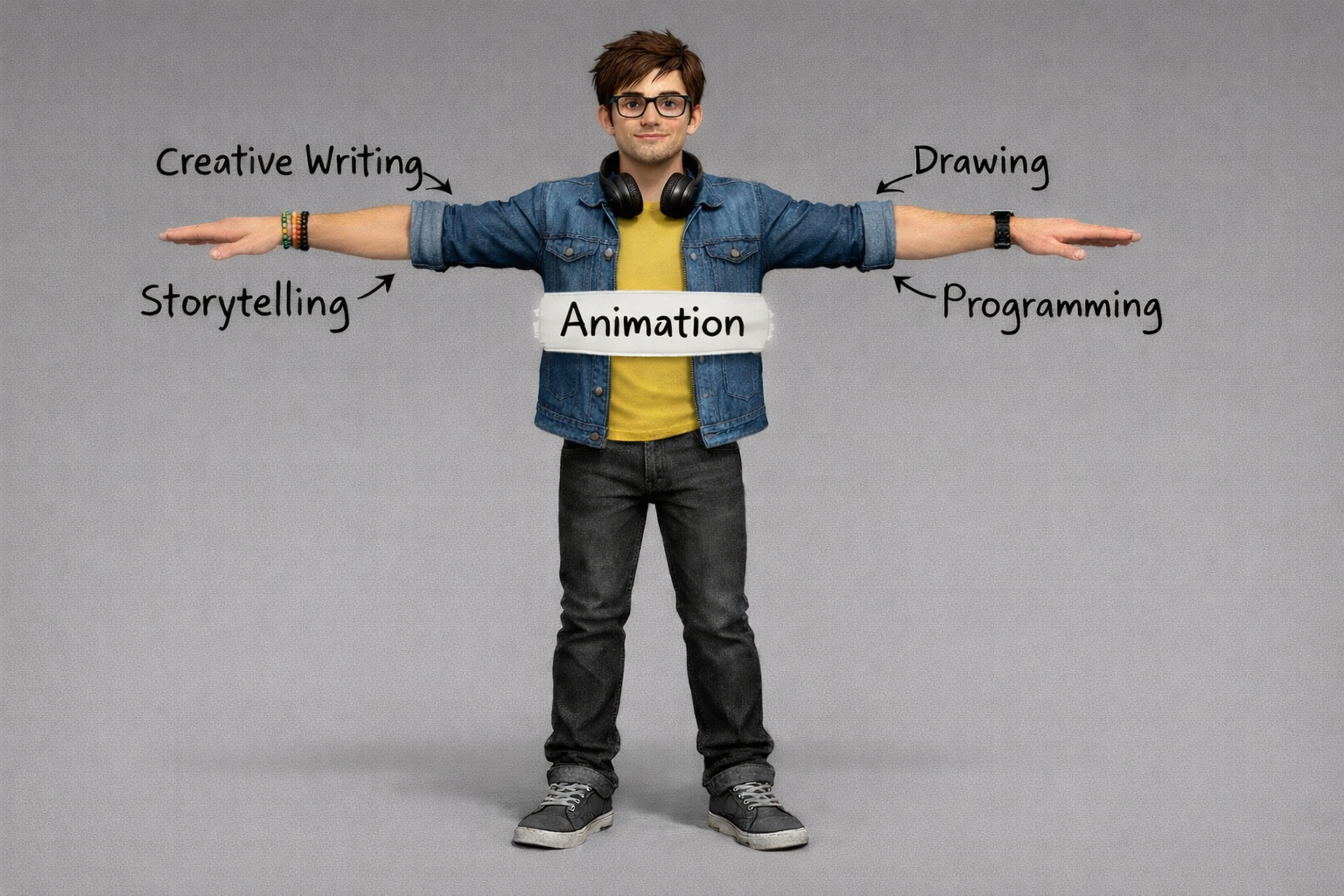
But the title of this article isn’t “look at my awesome SCAD degree!” Obviously, despite meeting some really great educators and talented students, I just couldn’t justify the cost of the education any longer, especially as AI crept in. It was also during this time in 2022 that tools like ChatGPT, MidJourney, Dall-E turned every creative industry on its head. People were worried about workflows, jobs, and whether humans would even be needed for game development pipelines. Worst of all, I could tell the wave was big and I wasn’t certain the SCAD professors knew how to handle it. There was too much of the let’s ignore this new stuff and get back to unwrapping your UVs manually and pretending an algorithm won’t do this in a couple years. I know I’m generalizing as Professor Nye, one of the leaders at SCAD, has personally written extensively about creativity and the AI.
Nevertheless, I didn’t see the curriculum in my game design courses responding to the onslaught of AI disruption coming and figured I’d be better off wandering the wilderness using my own judgment.
My Takeaways
Did I quit or was I just weeded out?
I’ll let you decide what you think. Maybe it was a little bit of both. For me, I did not have the patience to see if and when SCAD would respond to AI and give me the tools and frameworks necessary to contribute to the industry. It was also really disheartening to see so many jobs for creatives in the game industry disappearing without a real thought for how to transition those talents to other opportunities. I see so many opportunities for creatives to unleash their talent at companies like Boeing, especially as AI narrows the gaps between creative disciplines. It’s during this age I wish there was a design curriculum for “full stack designers.” I’m appropriating the term from years ago when web developers faced the same pressure to “do it all” by being proficient in front-end technologies and backend technology stacks. Developers wore badges of honor representing their tools of choice. Where my MEAN devs at?! I see the same trends happening with graphic designers expected to be proficient in vector/raster, still/motion, 3D/2D and static/immersive design. So, I don’t think art schools are bad or going away. But I don’t think it’s a good idea to build your degree programs off of specific industries, especially as “industries” may very well be entering the most transient period of our lives.
Your GPA means absolutely nothing
I don’t think I earned a single “B” in art school. And I know I’m not what one would call an A-list motion or game designer. Here’s the thing about graduate school: it is self-cleansing. As long as students give some semblance of effort, professors will gladly hand out As and Bs. And that went for Washington University in St. Louis as well as SCAD. After all, these students were also paying customers so there’s a bit of a conflict of interest in for-profit education. It’s easy for the job of the educator to become keeping the student on the ferris wheel for another semester. Perhaps there is a correlation with the subjectivity of art and the difficulty with deciding on how to grade a student.
Worst of all, I didn’t feel like my work was getting better even as my GPA stayed unblemished. It made my feel like I was surrounded by people who wouldn’t tell me if I had spinach in my teeth, let alone if my art or ideas were bad. That lack of trust was a real problem for me since I feel like that is a huge reason why I was paying these professors over just finding more learning content online.
Don’t expect professors to have all the answers
The creative “industry” (as if it were simply this monolithic sector) is ever-changing, both in terms of taste and technology. Your professors have their own preferences for taste and tools and yes, their sensibilities will one day be considered “out of touch.” However, that doesn’t mean they don’t have valuable insights to learn from. Initially, I expected a steady set of interactions with Mr. Miyagi every class, with the perfect insight at just the right time. The reality is professors still have a lesson plan to follow. This doesn’t mean they aren’t able to help with problems, but don’t expect the perfect words to provide you the clarity you crave. Professors are tour guides, not paid Hollywood actors reading a script.
Not all courses are created equal
Even SCAD has duds. Blame it on the “system” or whatever, but there were several classes that were significantly disappointing for the money they charge for them. Whether the assignments were outdated, the feedback uninspiring, unhelpful, or just unavailable. Like I mentioned earlier, the clock was ticking for me (and all of us, right?). After receiving too many vague responses, I couldn’t justify spending time and money without seeing an intellectual return on my investment.
It’s mostly about who you know
I would not have gotten that call from Sarofsky’s team I didn’t meet her at CoMotion. That is a huge advantage schools like SCAD hold over the DIY approach to learning: getting students connected to people looking for talent. At the same time, teams like Sarofsky aren’t just handing out gigs. They obviously saw something they liked in me and my work. I still had to put out some effort to get noticed. I needed to show up. I needed to prove I could contribute meaningfully to her team, and not be a jerk. So yes, network like your career depends on it…because it does. Just don’t skip the work.